If you’re searching for a clear, practical toddler development milestones guide, you likely want to understand what’s normal, what to expect next, and how to support your child’s growth with confidence. The early years move fast, and it can be overwhelming to track physical, emotional, language, and social milestones without reliable guidance.
This article is designed to give you a structured, easy-to-follow toddler development milestones guide that breaks down key stages in simple terms. You’ll learn what skills typically emerge at different ages, how to encourage healthy development through everyday routines, and when it might be time to seek professional advice.
Our insights are grounded in established child development research and pediatric recommendations, combined with practical parenting strategies that work in real homes. By the end, you’ll have a clearer understanding of your toddler’s progress—and actionable ways to support their growth with confidence.
The toddler years (ages 1–3) feel like watching a time‑lapse video of a sunflower turning toward the sun—sudden, astonishing, a little unreal. One minute they’re wobbling; the next they’re scaling couches like tiny Avengers.
If you’ve ever whispered, “Is my child on track?” you’re not alone. This isn’t a rigid checklist; it’s a reassuring toddler development milestones guide designed to inform, not alarm.
Every child grows at their own rhythm.
We’ll explore key milestones in:
- cognitive skills
- social and emotional growth
- language development
- physical abilities
Think of it as your parenting roadmap. Confidence included. No pressure.
The Explorer: Key Milestones from 12 to 18 Months
Between 12 and 18 months, your baby becomes an Explorer. This stage is all about testing limits, building strength, and figuring out how the world works (often by dropping things repeatedly just to see your reaction).
Movement & Physical Development:
This is when many toddlers go from tentative first steps to confident walking. Some begin pulling toys behind them or attempting to climb furniture. Scribbling also appears. Scribbling isn’t “just doodling”—it’s an early fine motor skill, meaning small muscle movements in the hands and fingers that prepare them for later writing.
Language & Communication:
You may hear a few single words like “mama” or “dada.” They start responding to simple requests such as “come here.” Gestures—pointing, waving, or shaking their head—are part of expressive language, which means how they communicate their needs before full sentences arrive.
Cognitive (Learning & Thinking):
Toddlers explore objects by shaking, banging, or throwing them. This is cause-and-effect learning—understanding that “when I do this, that happens.” They also begin copying gestures you make, a skill called imitation, which builds memory and social understanding.
Social & Emotional:
Stranger anxiety may peak. They show affection with hugs but may also have temper tantrums. A tantrum is an emotional overload, not manipulation.
If you ever feel unsure, a toddler development milestones guide can help clarify what’s typical and when to seek support.
The Budding Communicator: Milestones from 18 to 24 Months
Between 18 and 24 months, toddlers transform from wobbly explorers into determined little communicators (with very strong opinions). This stage is packed with visible growth—and knowing what to look for helps you respond with confidence.
Movement & Physical Development
At this age, many toddlers walk up and down stairs while holding a railing or your hand, kick a ball, and even attempt short bursts of running. If you want to encourage this safely, try:
- Practicing stair climbing with supervision.
- Rolling and gently kicking a soft ball back and forth.
- Creating safe “run zones” at the park.
Some parents worry if their child isn’t running yet. However, the CDC notes that development varies widely within normal ranges (CDC, 2023). Progress matters more than perfection.
Language & Communication
Vocabulary often expands to 50+ words, and toddlers begin combining two words like “more milk.” They also point to pictures when named. To actively boost this growth, read daily and label everything you see. For deeper strategies, explore how to support language development in toddlers at home.
Pro tip: Pause after asking a question—processing time helps toddlers respond.
Cognitive Growth
Toddlers start sorting shapes and colors and enjoy simple make-believe (feeding a stuffed bear). Give two-step directions like, “Pick up the ball and give it to me.” It builds working memory—meaning the brain’s ability to hold and use information briefly.
Social & Emotional Development
You’ll notice increasing independence and parallel play (playing beside, not directly with, other kids). While some think sharing should be automatic by now, true cooperative play usually develops later (AAP, 2022).
Use this toddler development milestones guide as a reference—not a race chart. Every child develops in their own rhythm.
The Little Person: Milestones for 2- to 3-Year-Olds
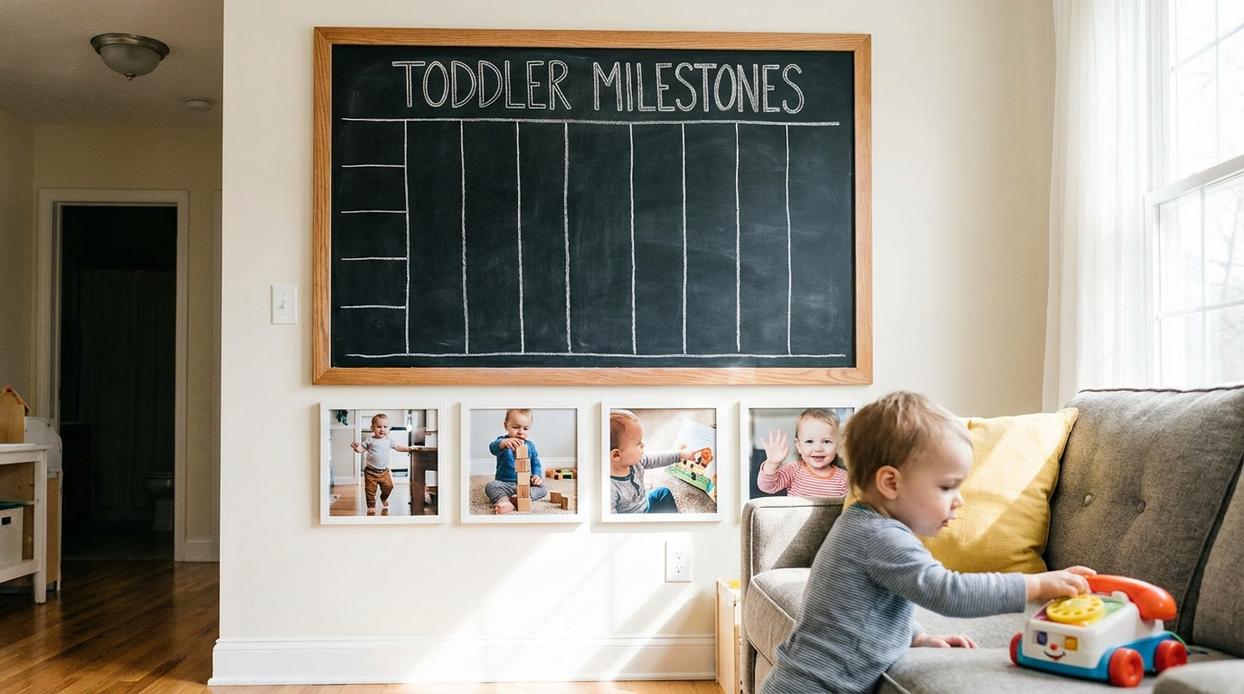
Between ages two and three, your toddler transforms from a wobbly explorer into a confident little human with opinions (so many opinions). While every child develops at their own pace, this stage brings exciting, visible growth.
Movement & Physical Development
At this age, many toddlers climb confidently, run with fewer tumbles, pedal a tricycle, and turn book pages one at a time. To support this, create safe climbing opportunities at the playground and practice “stop and go” running games in open spaces. If your child prefers being carried, you might wonder if they’re behind. Often, they just need encouragement and repetition. Pro tip: Rotate outdoor toys weekly to keep movement exciting.
Language & Communication
You’ll likely hear multi-word sentences, their name and age proudly announced, and clearer speech understood by familiar listeners. Encourage this by narrating daily routines: “We’re putting on blue socks.” Additionally, ask simple choices like “Apple or banana?” to build vocabulary. Some argue late talkers should be left alone. However, research from the American Academy of Pediatrics shows early language engagement supports stronger communication skills later on.
Cognitive (Learning & Thinking)
Toddlers begin working toys with buttons and levers, completing 3- or 4-piece puzzles, and understanding concepts like “two.” Try counting snacks together or modeling problem-solving aloud. Think of it as their first mini science lab (minus the lab coats).
Social & Emotional
Expect big feelings, copying behaviors, concern for crying friends, and strong ideas about “mine” and “theirs.” Practice sharing through short, timed turns. For a broader overview, consult a toddler development milestones guide to track patterns—not perfection.
How to Nurture Growth and When to Check In
First and foremost, supporting your child’s development doesn’t require expensive toys or elaborate schedules. Simple, consistent habits matter most. Read together daily (yes, even the same book for the hundredth time), talk about your day during meals, and encourage active play outdoors. Additionally, offer open‑ended toys like blocks or basic puzzles to strengthen problem‑solving skills. Research shows that responsive interaction—back‑and‑forth conversation and shared attention—significantly supports language and cognitive growth (Harvard Center on the Developing Child).
However, milestones are guidelines, not deadlines. While some worry about “falling behind,” development isn’t a race. Small variations are normal. A toddler development milestones guide can help you spot patterns over time rather than isolated delays.
Most importantly, trust your instincts. If you notice a consistent pattern of missed milestones or the loss of a skill, checking in with a pediatrician is proactive—not alarmist. Peace of mind is powerful (and often underrated).
Think of childhood as a garden unfolding in seasons. A toddler development milestones guide isn’t a measuring stick; it’s a weather map helping you notice each new bloom. When you see growth this way, worry melts into wonder. You’re not racing a clock—you’re tending something beautifully, uniquely alive every day.
Supporting Your Toddler’s Growth With Confidence
You came here looking for clarity on your child’s growth—and now you have a clearer understanding of what healthy progress looks like, what signs to watch for, and how to confidently support each new stage. Navigating early childhood can feel overwhelming, especially when you’re unsure whether your toddler is “on track.” That uncertainty can create stress, second-guessing, and constant comparison.
The good news? With the right knowledge and simple daily support, you can turn that worry into confidence. Following a structured toddler development milestones guide helps you recognize progress early, respond proactively to delays, and create routines that nurture learning, speech, motor skills, and emotional growth.
If you’re ready to stop guessing and start guiding your toddler with clarity, explore our trusted resources designed to simplify every stage. Join thousands of parents who rely on our practical, research-backed tools to make development easier and less stressful. Start today and give your child the strong, confident start they deserve.